
Clinch County Superior Court
Georgia's court structure uses Superior Court as the trial court of general jurisdiction. The State Court Structure Map for Clinch County says Superior Court is the correct visible court name for the primary trial-court content. It handles felonies, divorce, broad civil cases, and correction of errors from limited-jurisdiction courts. The Council of Superior Court Judges listing for Clinch County places the local Superior Court at 25 Court Square in Homerville and identifies the clerk as the local records contact.
Clinch County is part of the Alapaha Judicial Circuit, a multi-county circuit that also includes Atkinson, Berrien, Cook, and Lanier counties. The circuit site provides court links, calendars, self-help forms, programs, directory contacts, and current announcements. Local case files and copies still depend on the Clinch County Clerk of Superior Court at 25 Court Square, Suite C.
No Clinch County District Court
Georgia is not a district-court state for local trial-court naming. The statewide court guide identifies seven trial-level court classes: Superior Court, State-wide Business Court, State Court, Juvenile Court, Probate Court, Magistrate Court, and Municipal Court. The phrase "district court" is more likely to cause confusion in Clinch County because federal courts use that term, while the local general trial court is Superior Court.
The filename can remain `district-court.html`, but visible content should read Superior Court. That wording helps users distinguish local state cases from federal cases. A divorce decree, felony indictment, civil judgment, or Superior Court docket entry is not searched through the U.S. District Court unless a federal case exists. For county case copies, start with the Clinch County Clerk of Superior Court.
The Middle District of Georgia qualifying-county page shows how federal district divisions work in Georgia.
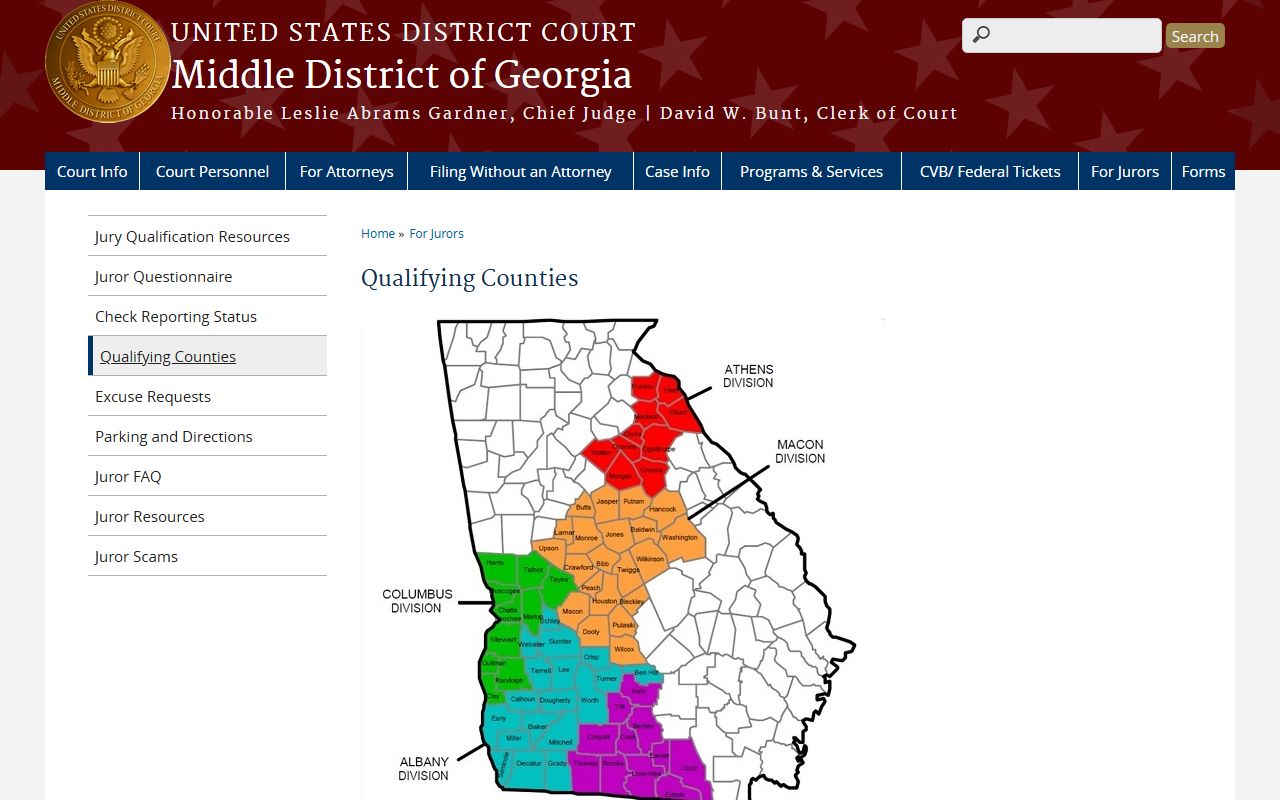
This federal district source is useful only for separating federal venue from Clinch County Superior Court case access.
Clinch County Court Table
Clinch County does not have a list of numbered district courts. The useful table is the local court and office table from the research file. It shows which office handles each record type and where a records user should begin. Superior Court sits at the top of the local trial-court path for felonies, divorce, broad civil cases, and appeals or corrections from limited courts.
| Court or Office | Address | Phone | Jurisdiction and Records |
|---|---|---|---|
| Clinch County Superior Court | 25 Court Square, Homerville, GA 31634 | Clerk 912-487-5854 | Felonies, divorce, broad civil cases, lower-court error review, and criminal or civil case files through the Clerk of Superior Court. |
| Clerk of Superior Court | 25 Court Square, Suite C, Homerville, GA 31634; P.O. Box 433 | 912-487-5854; fax 912-487-2316 | Superior and Juvenile Court records, criminal cases and warrants, civil cases, divorces, adoptions, name changes, garnishments, real estate, Fi. Fas., military discharges, notary, and jury work. |
| Probate Court | 110 Court Square, Homerville, GA 31634 | 912-487-5523; fax 912-487-5507 | Wills, estates, guardianships, conservatorships, involuntary hospitalization, marriage licenses, weapons carry, and vital records. |
| Magistrate Court | 110 Court Square, Homerville, GA 31634 | 912-487-2514; fax 912-487-5507 | Small claims under $15,000, dispossessory writs, bad-check warrants, arrest and search warrants, preliminary hearings, and bail. |
| Juvenile Court | Clerk records at 25 Court Square, Suite C | 912-487-5854 | Juvenile matters; the Clerk of Superior Court serves as Court Clerk to Juvenile Courts of Clinch County. |
| Homerville Municipal or traffic payment channel | 20 South College St., Suite A, P.O. Box 535, Homerville, GA 31634 | Court Clerk Lucy Ann Wells 912-487-3166 | Homerville traffic tickets through the Government Window payment channel. |
Clinch County Court Types
Superior Court should not be confused with Probate Court, Magistrate Court, Juvenile Court, or Municipal Court. Each has a different record set. The Georgia guide places Superior Court over felony trials, divorce, and broad civil jurisdiction. The research states that Magistrate Court has no jury trials in Clinch County and handles small claims under $15,000, warrants, preliminary hearings, dispossessory matters, bad checks, and bail when not reserved to another judge.
| Point | Superior Court | Probate Court | Magistrate Court | Municipal Court |
|---|---|---|---|---|
| Main local role | General trial court for major civil, divorce, felony, and review matters. | Estates, wills, guardianships, marriage licenses, weapons carry, and vital records. | Small claims, dispossessory, warrants, preliminary hearings, and some bail matters. | City traffic, ordinance, and municipal matters where created. |
| Civil limit | Broad civil jurisdiction in Georgia trial-court structure. | Probate and guardianship jurisdiction, not general civil trial jurisdiction. | Small claims under $15,000 in Clinch County research. | City-created jurisdiction, tied to ordinance and traffic matters. |
| Criminal role | Felony trials and Superior Court criminal case files. | Traffic or certain misdemeanor authority may exist in counties without state court, but local Clinch traffic details were not published. | Arrest and search warrants, preliminary hearings, bail, and minor or felony criminal first-stage matters. | Municipal traffic and ordinance matters. |
| Record custodian | Clerk of Superior Court. | Probate Court office. | Probate and Magistrate Court office. | City or municipal court clerk, including Homerville traffic contact when applicable. |
Note: Georgia's State Court is a separate limited county court where created by local law, but no separate Clinch County State Court page was located.
Clinch County Case Flow
A Clinch County criminal matter often starts outside Superior Court. Law enforcement may arrest or seek a warrant, Magistrate Court may handle a first appearance, warrant, preliminary hearing, or bail issue, and the District Attorney decides how indictable offenses proceed. Once a felony case moves into Superior Court, the file may include indictment or accusation material, arraignment, motions, pleas, orders, trial entries, disposition, sentence, probation terms, and appeal notices.
Criminal flow: Arrest or warrant › Magistrate first appearance or preliminary hearing › District Attorney charging decision › indictment or accusation › arraignment › motions and hearings › plea or trial › disposition and sentence › appeal if filed.
Civil and family flow: Petition or complaint filed › service and answer › motions or temporary orders › discovery and mediation when used › hearing or trial › judgment, decree, or order › post-judgment action or appeal.
The Alapaha Judicial Circuit calendar page separates monthly calendars, annual calendars, weekly hearings, calendar call, and civil trial calendars. It is the better calendar source than a guessed local docket schedule.
The U.S. Bankruptcy Court for the Middle District of Georgia homepage is a separate federal source for bankruptcy court locations and contact context.
Calendar and filing sources should be matched to the case type because bankruptcy and federal schedules are not local Superior Court schedules.
Alapaha Superior Court Circuit
The Alapaha Judicial Circuit gives Clinch County its regional Superior Court context. The research states that the circuit includes Clinch, Atkinson, Lanier, Cook, and Berrien counties. Its homepage lists the circuit contact at 201 N. Davis Street, Room 261, Nashville, GA 31639, phone 229-686-2180. The directory lists court administrator Bridgette Cersey, judicial assistants for Chief Judge Clayton A. Tomlinson, Judge Richard L. "Dick" Perryman III, and Judge Matthew B. Bennett, along with court reporters Gwen Robertson and Lisa Jackson.
The circuit also provides programs and forms that can appear in court records. Its programs page lists Accountability Court, ADR mediation for civil and domestic matters, In the Best Interest of the Children classes, The Haven, Legal Aid Program, and Student Attendance and School Climate Committees. Its self-help forms include record restriction, habeas, sentence modification, first-offender sealing, divorce, name change, protective orders, probate forms, and magistrate forms.
The U.S. Attorney's Office for the Middle District of Georgia prosecutes federal criminal matters and is separate from the Alapaha Judicial Circuit District Attorney.
Federal prosecution records do not replace the Superior Court criminal case file maintained locally after a state case is filed.
Superior Court Record Types
Clinch County Superior Court records cover more than one case class. Civil cases can include complaints, petitions, answers, summonses, service returns, motions, orders, judgments, Fi. Fa. entries, and garnishment paperwork. Family records include divorce and annulment filings, custody-related filings in domestic cases, name restoration material, and orders. Criminal records include accusations, indictments, charges, pleas, docket entries, orders, sentence sheets, probation terms, and disposition when public and not sealed.
Some filings stay restricted even when the case type is tied to Superior Court or the Clerk of Superior Court. Juvenile records have specialized access rules. Adoption records are not ordinary open public files. Record restriction under Georgia law can limit public access to qualifying criminal-history information. Protective-order records may be partly public while safety-sensitive details are protected.
- Disposition
- The current or final outcome of a case or charge, such as dismissed, granted, guilty plea, verdict, sentence, or closed.
- Indictment
- A grand-jury charging document for an indictable criminal offense.
- Fi. Fa.
- Fieri facias, a judgment lien or execution record tied to collection after judgment.
- Record restriction
- Georgia's process for limiting public dissemination of qualifying criminal-history information.
Federal District Distinction
Clinch County is in the federal Middle District of Georgia, Valdosta Division. Federal cases can include federal crimes, federal-question civil suits, civil rights cases, diversity actions, habeas or prisoner matters, and federal agency litigation. Those dockets are not held by the Clinch County Superior Court clerk unless a state case has a local record before removal or related action.
The U.S. Bankruptcy Court for the Middle District of Georgia county table lists Clinch County with filing location Valdosta. The bankruptcy homepage lists court locations including Macon and Columbus, and the research notes that users should confirm filing logistics before travel because only some divisional offices are regularly staffed. Federal bankruptcy records are searched through federal bankruptcy systems, not through a Clinch County Superior Court case search.
The U.S. Bankruptcy Court county filing-location table lists Clinch County in the Middle District bankruptcy system.
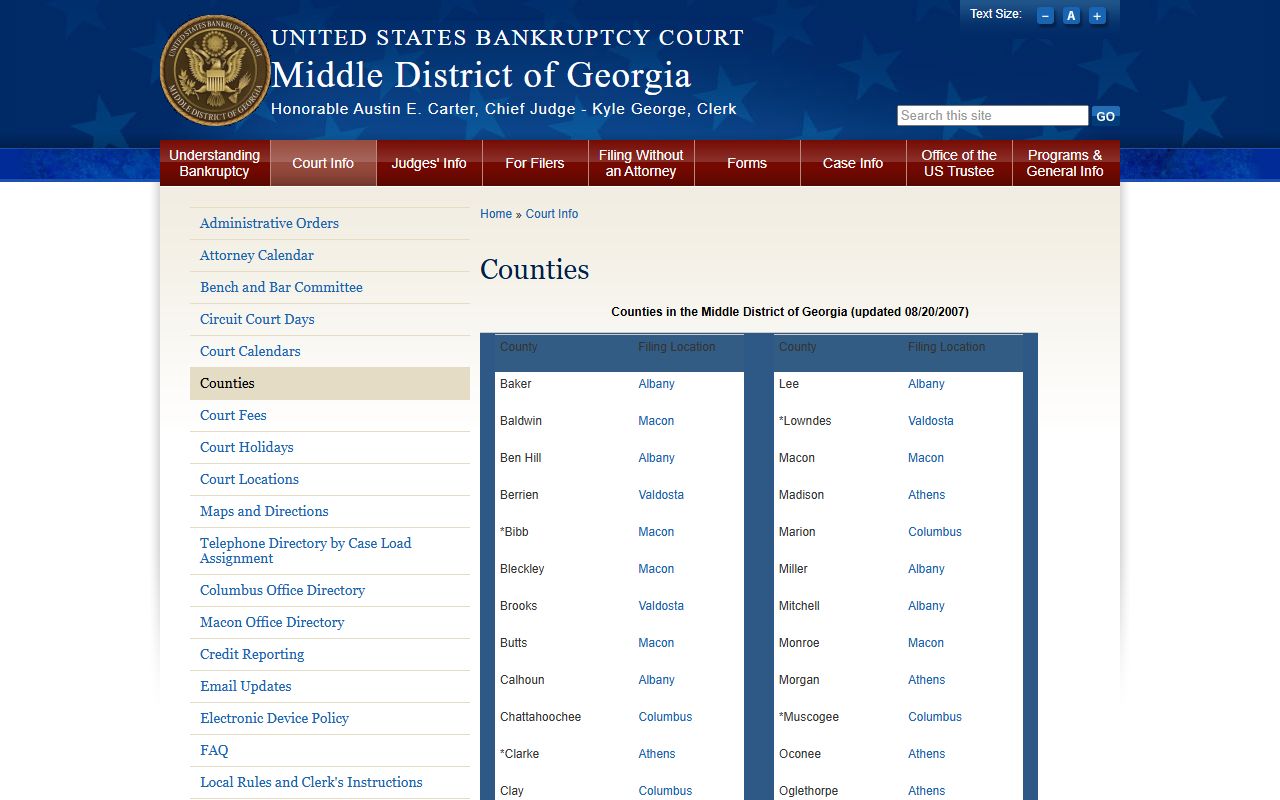
That bankruptcy source supports federal filing-location questions, not local Superior Court copy or docket questions.
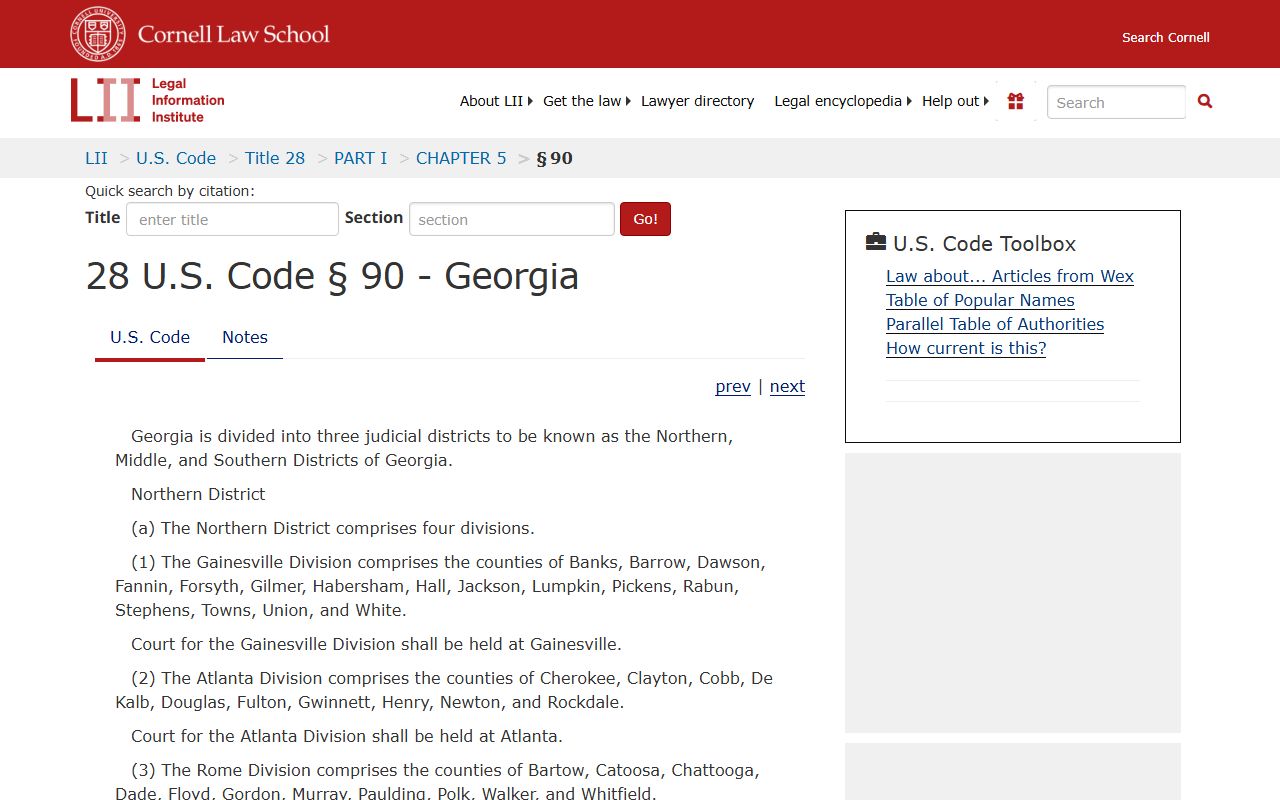
The federal statute at 28 U.S.C. 90 defines Georgia's federal judicial districts and supports the Valdosta Division distinction for Clinch County.
Use bankruptcy court contacts for bankruptcy filings and the Clinch County clerk for state Superior Court files.
Clinch Superior Court Access
For Superior Court records, the local access path starts with the Clerk of Superior Court. The office is at 25 Court Square, Suite C, Homerville, GA 31634, with phone 912-487-5854, fax 912-487-2316, and GSCCCA-listed hours of 8:00 a.m. to 5:00 p.m., Monday through Friday. Georgia Courts E-Access, PeachCourt, and re:SearchGA may be useful account-based or provider-based platforms, but the research did not confirm a public open Clinch case-search page through those systems.
A good Superior Court request should include party names, case number if known, case type, filing year, document name, copy type, and return method. Ask for certified copies when another court, agency, lender, title party, or legal process needs clerk certification. If the record is sealed, restricted, juvenile, adoption-related, or safety-sensitive, the clerk may limit access or require a court order.
Note: PACER is for federal dockets; Clinch County Superior Court records are requested through the local clerk.
Clinch County Court Setting
Clinch County court access is shaped by its Court Square layout. The Clerk of Superior Court is at 25 Court Square, Probate and Magistrate Court is at 110 Court Square, and the Sheriff and Jail are at 115 Court Square. A records user may need more than one office on the same trip. The county seat is Homerville, and the county history page says Clinch was founded in 1850 from parts of Lowndes and Ware counties.
The local court system also reflects a rural circuit model. The Alapaha Judicial Circuit spreads judges, prosecutors, defenders, calendars, and programs across several south Georgia counties while keeping Clinch County's clerk records in Homerville. That is why a calendar may appear on the circuit site, a prosecution contact may be in Nashville, a public defender contact may be in Adel, and a certified Superior Court copy may still come from the Clinch County Clerk of Superior Court.
Public Record Search
Sponsored Results