
Clinch County Arrest Records Overview
Clinch County arrest records start on the law-enforcement side. The official Clinch County Sheriff's Office page identifies Sheriff Raymond Peterson and places jail operation, patrol, criminal investigations, K-9 work, court security, court-order processing, and neighborhood patrol under the sheriff's office at 115 Court Square in Homerville. When a person is booked into the Clinch County Jail, the booking side may show identity, custody, arresting agency, booking charge, bond action, and first-appearance information, when those facts are available from the jail. The research did not locate an official public jail roster, so arrest and booking questions should start with the jail phone line rather than a third-party roster site.
Court charges after arrest are the court side of the same event. The Clinch County Clerk of Superior Court files criminal cases and maintains criminal warrants, while Magistrate Court handles arrest warrants, search warrants, preliminary hearings, bad-check warrants, good behavior warrants, and bail matters not reserved to another judge. The Alapaha Judicial Circuit District Attorney represents the state in Superior Court criminal cases, prepares indictments or presentments when requested by a grand jury, and prosecutes indictable offenses. For the full case file and final sentence, use Clinch County criminal court records.
The GDC Clinch County Jail location page confirms the county jail address and phone used for local booking questions.
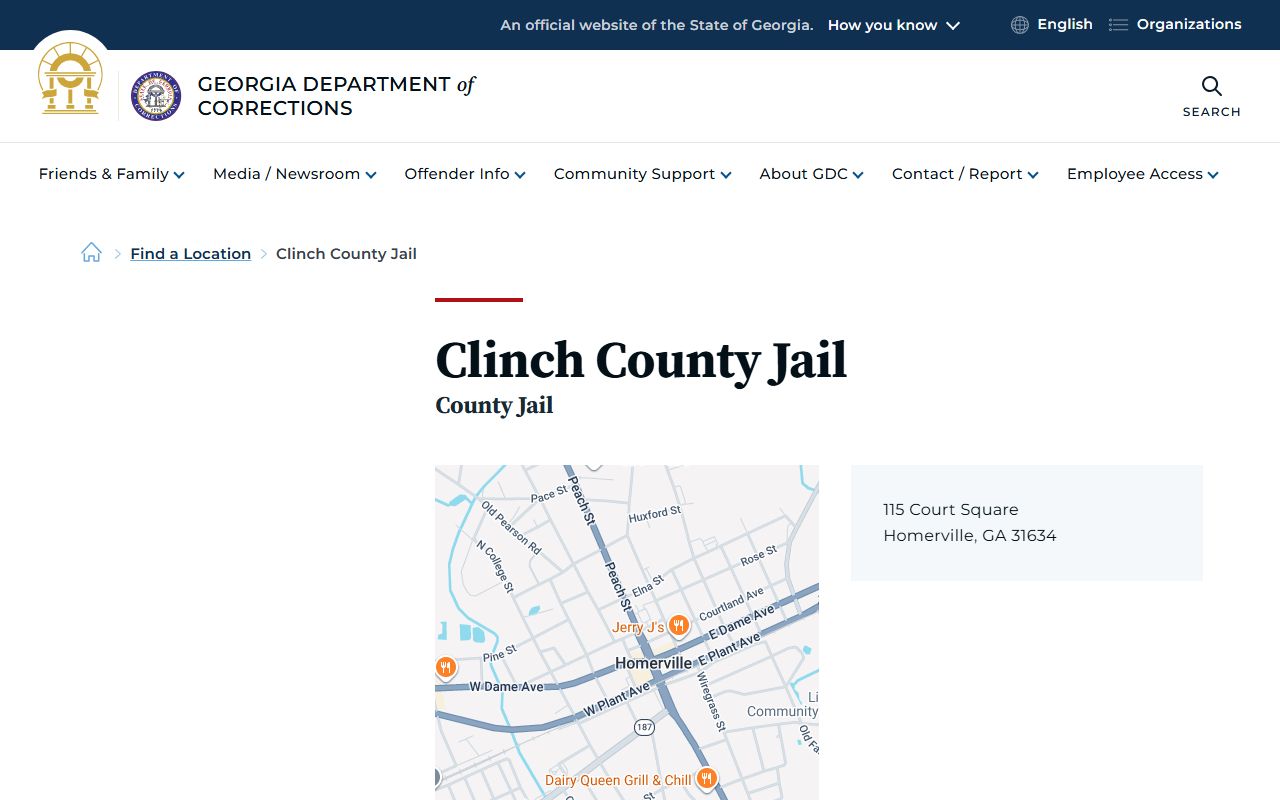
That jail source supports the arrest-record side, while filed charges still have to be checked with the court or prosecutor record custodian.
Clinch County Charges After Arrest
A booking charge can be a first label used at intake. It is useful, but it is not the final court charge. After an arrest, the path may run through a warrant, a magistrate first appearance, a bond decision, and then prosecutor review. In felony and other indictable matters, the District Attorney decides how the state proceeds in Superior Court. The Clerk of Superior Court then keeps the criminal case file, including accusations, indictments, pleas, docket entries, orders, sentence, probation terms, and disposition when the file is public and not sealed.
For Clinch County, the practical search chain is office-first. Call the sheriff or jail for custody and booking facts, call Magistrate Court for warrant, preliminary-hearing, and bail questions, call the Clerk of Superior Court for criminal warrants and case-file records, and use the District Attorney's office for prosecution context when the charge has moved into Superior Court. Georgia Courts E-Access, PeachCourt, and re:SearchGA may help with account-based court-document access in Georgia, but the research did not confirm a public Clinch case-search page that exposes all criminal charge details online.
| Record Point | Likely Clinch County Contact | What It Can Clarify |
|---|---|---|
| Booking or custody | Clinch County Sheriff / Jail, 912-487-5316 | Whether a person is held locally and what jail instructions apply. |
| Warrant, first appearance, bail | Magistrate Court, 912-487-2514 | Arrest or search warrant records, preliminary hearing path, and bail matters. |
| Filed criminal case | Clerk of Superior Court, 912-487-5854 | Criminal warrants, accusations, indictments, docket entries, orders, and disposition. |
| Prosecution decision | District Attorney, 229-686-7015 | Superior Court prosecution role and victim-assistance contact routing. |
Clinch County Charging Documents
The charging document is the point where an accusation becomes a court record. Georgia court records may use terms such as warrant, accusation, indictment, plea, disposition, and sentence. In Clinch County, Magistrate Court is important early because it handles arrest warrants, search warrants, preliminary hearings, and bail in many matters. Superior Court is the trial court of general jurisdiction for felonies, and the Clerk of Superior Court keeps the criminal case records once the matter is filed there.
| Charging Document | Who Uses It | How It Fits Clinch County Records |
|---|---|---|
| Complaint or warrant | Law enforcement, complainant, prosecutor, or magistrate process | May begin arrest, search, bad-check, good-behavior, preliminary-hearing, or bail records in Magistrate Court. |
| Accusation | Prosecutor | Formal charge filing that can appear in a public criminal case file when not sealed or restricted. |
| Indictment | Grand jury with prosecutor involvement | Formal grand-jury charging document for indictable offenses handled through Superior Court. |
The Georgia.gov warrant guide gives the official state-level reminder to contact the county sheriff for warrant information.
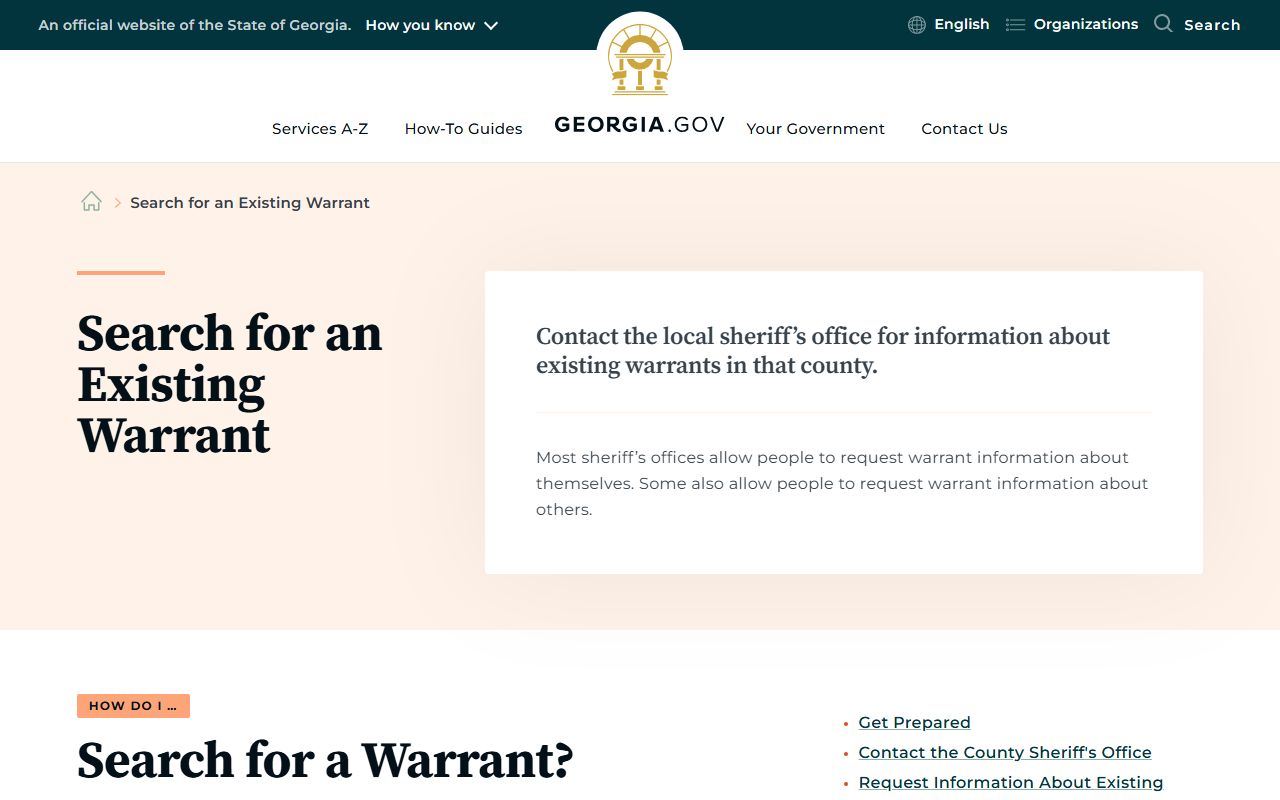
That warrant source matters because many Clinch County charge checks begin with whether a warrant or magistrate proceeding exists.
Clinch County Charge Status
A charge can change without the arrest record changing. The court record may show a pending charge, an amended count, a reduced offense, a dismissed count, a nolle prosequi entry, a dead docket entry, a plea, a verdict, or a sentence. A person can also have more than one charge from a single arrest. Each charge should be read separately, because one count may be dismissed while another moves to plea or sentencing.
| Status | Meaning in a Charge Record | Where to Verify |
|---|---|---|
| Pending | The charge has not reached final disposition in the available court record. | Clerk docket entries or issuing court. |
| Amended or reduced | The original charge was changed, often through prosecutor action or plea negotiation. | Charging paper, amended accusation, plea form, or order. |
| Dismissed | The court record shows the count or case was dismissed. | Dismissal order or docket entry from the clerk. |
| Nolle prosequi | The prosecutor made a formal decision not to proceed on the charge. | Clerk case file and prosecutor filing. |
| Dead docket | The prosecution is inactive but may not equal a final dismissal. | Superior Court case docket and any later order. |
Note: Georgia uses record restriction language for many criminal-history limits, so do not assume every old dismissed charge is publicly searchable.
Clinch County Charges vs Convictions
A charge is an accusation. A conviction is the result of a guilty plea, guilty verdict, or other final finding that supports judgment and sentence. That distinction is central to Clinch County arrest records because booking and charging facts may appear before a case is resolved. Public users should avoid treating an arrest, warrant, or filed charge as proof that the person was convicted.
| Point of Comparison | Charge | Conviction |
|---|---|---|
| Stage | Appears after arrest, warrant, accusation, or indictment. | Appears after plea, verdict, or judgment. |
| Meaning | States what offense is alleged. | States what offense was proven or admitted. |
| Record Location | May appear in warrants, booking, Magistrate Court, and Superior Court files. | Appears in disposition, sentence, probation, and criminal-history records when public. |
| Risk of Misreading | May be amended, reduced, dismissed, or not prosecuted. | Can still be affected by appeal, first-offender treatment, sealing, or restriction. |
State Charge Lookup Limits
Georgia has several statewide or state-linked systems, but none replaces the Clinch County offices. Georgia Courts E-Access says users are redirected to providers and must have an account. PeachCourt is a Georgia e-filing and court-document platform for civil and criminal e-filing and document access. re:SearchGA is a cross-county court-record platform for participating counties. The research did not confirm that these tools expose every Clinch County charge, warrant, or disposition to the public.
For criminal-history limits, O.C.G.A. 35-3-37 governs many record-restriction issues. Juvenile court-file inspection and juvenile sealing are controlled separately under Georgia juvenile statutes. If a charge is tied to a juvenile case, adoption file, sealed matter, first-offender sealing, or restricted criminal history, public access may be limited even when an adult criminal docket would otherwise be public.
Important: Arrest records, charges, and background reports must not be used for FCRA-regulated screening unless the source and use comply with federal law.
Clinch County Sealed Charge Records
Georgia research for Clinch County points to record restriction and sealing, not a blanket promise that every charge can be erased. The Alapaha self-help forms page includes a Record Restriction form and a Motion to Seal Records of First Offender form. Juvenile files are handled under separate Georgia juvenile statutes, and adoption or mental-health matters can have their own confidentiality rules. A restricted criminal-history entry, sealed court file, and ordinary dismissed charge are different access issues.
| Access Status | What It Means | Clinch County Checkpoint |
|---|---|---|
| Sealed | The court limits public access to the file or selected documents. | Ask the clerk or court what order controls access. |
| Record restricted | Georgia law limits public dissemination of qualifying criminal-history information. | Review O.C.G.A. 35-3-37 and local court forms. |
| Juvenile sealed | Juvenile files follow special access and sealing rules. | Use juvenile court procedures, not adult criminal access assumptions. |
| Not located online | The record may require an office request or may not be publicly accessible. | Call the custodian before assuming the charge does not exist. |
Clinch County Charge Help
The District Attorney is the prosecution contact, not the defense contact. The Clinch County DA page lists District Attorney Chase Studstill for the Alapaha Judicial Circuit, with office address P.O. Box 158, 115 South Davis Street, Nashville, GA 31639, phone 229-686-7015, and Victim Assistance Program phone 229-686-7856. The DA represents the state in Superior Court criminal cases for Clinch, Atkinson, Lanier, Cook, and Berrien counties.
The public-defense source for the Alapaha Circuit identifies the circuit public defender office in Adel. For a charge that could lead to jail, probation, a criminal-history entry, or a bond violation, legal advice should come from counsel, not from a clerk. The Alapaha Judicial Circuit directory shows the circuit structure around Clinch County court administration.
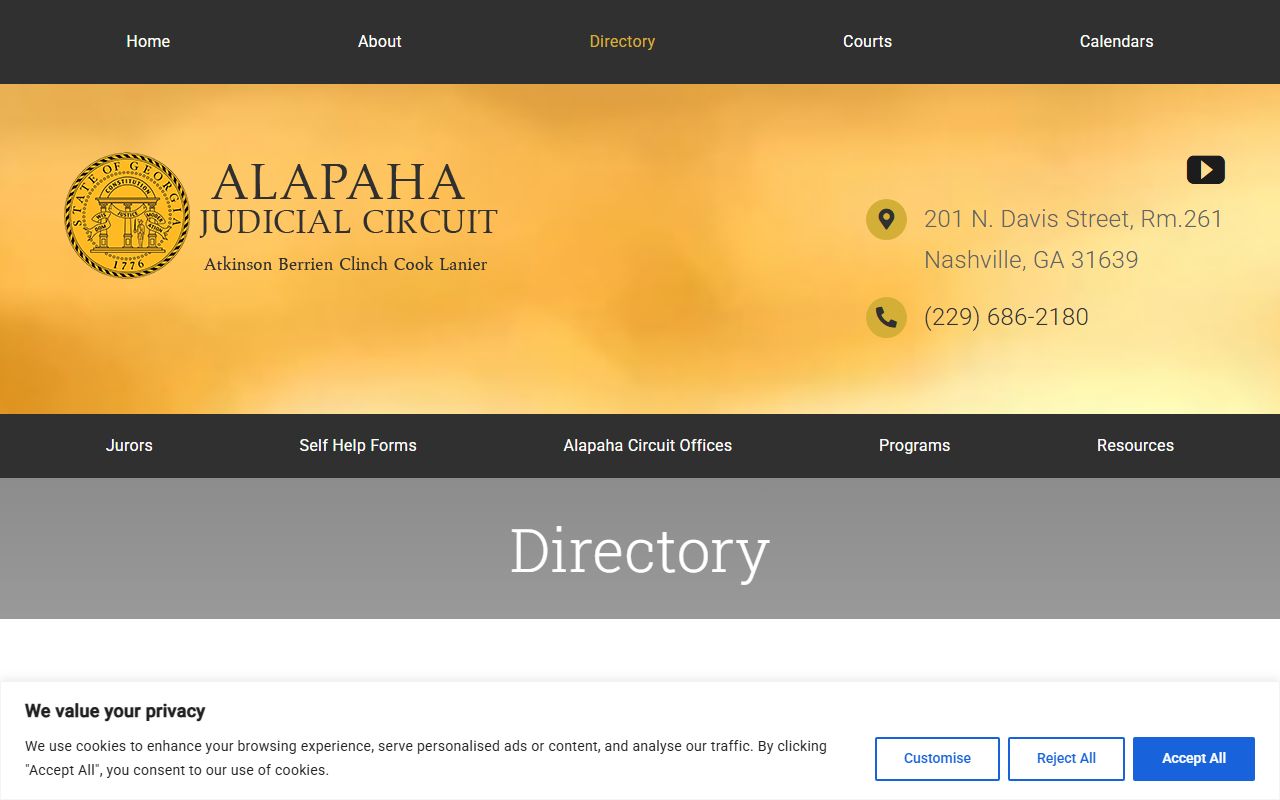
The circuit directory is useful because Clinch County criminal charge records sit inside a multi-county judicial circuit rather than a single-county court administration.
Restricted Clinch County Charge Records
Not every charge record is open to the public. Georgia public-record rules are broad, but they do not override rules for sealed records, juvenile files, adoption records, mental-health matters, protected personal identifiers, and record-restricted criminal-history information. The Alapaha self-help forms page includes a Record Restriction form and a Motion to Seal Records of First Offender form, which supports the research finding that restriction and sealing are real access issues in local criminal records.
Use precise request terms when contacting Clinch County offices. Ask whether the record needed is a jail booking entry, warrant, accusation, indictment, docket sheet, plea, disposition, sentence, or certified copy. Include the defendant name, case number if known, approximate date, record type, and return method. If the clerk or court says the record is sealed or restricted, ask for the legal basis or the procedure for requesting access rather than assuming the file does not exist.