
Clinch County Criminal Court Records
Clinch County criminal court records focus on the case file kept by the court once charges are filed. The Clerk of Superior Court page says the clerk files criminal cases and maintains criminal warrants. Under Georgia's court structure, Superior Court is the general-jurisdiction trial court and handles felony trials. Magistrate Court can be involved earlier for warrants, preliminary hearings, arrest and search warrants, bad-check warrants, good behavior warrants, and bail matters that are not reserved to another judge.
The District Attorney for the Alapaha Judicial Circuit represents the state in Superior Court criminal cases for Clinch, Atkinson, Lanier, Cook, and Berrien counties. The DA prepares indictments or presentments when requested by the grand jury, prosecutes indictable offenses, argues criminal appeals, and supervises the Victim Assistance Program. That prosecuting role is separate from the jail booking process and separate from the clerk's case-file custody. For a closer look at the charge itself after arrest, use the separate court charge records material; the full criminal case file belongs here.
The GPDC Alapaha Circuit public defender page identifies the circuit public defender office serving Clinch County.
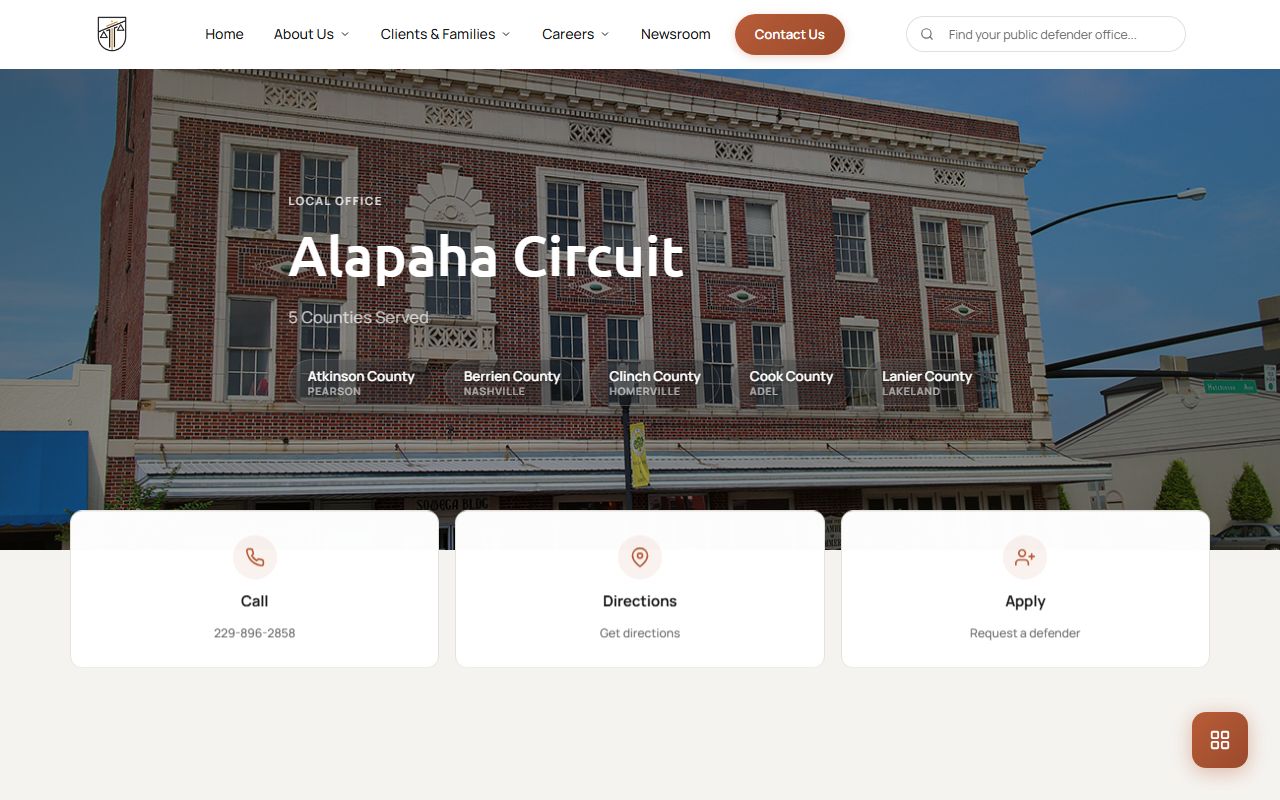
Public defender contact information is part of the criminal case ecosystem, but it does not replace the clerk's role as case-file custodian.
Search Clinch County Criminal Court Records
No single official public Clinch County criminal court records portal was confirmed in the research. Start with the Clerk of Superior Court for Superior Court criminal case files and criminal warrants. For preliminary hearing, warrant, or bail questions, contact Magistrate Court. For hearing dates and calendar calls in Superior Court, use the Alapaha Judicial Circuit calendar page. Account-based options such as Georgia Courts E-Access, PeachCourt, and re:SearchGA may help where Clinch County participation and access are available, but absence from a portal does not prove absence of a court case.
- Gather the defendant name, approximate filing date, charge description, case number if known, and court level.
- Contact the Clerk of Superior Court for felony case files, Superior Court criminal warrants, pleas, dispositions, sentence entries, and certified copies.
- Use the Alapaha Judicial Circuit calendars for Superior Court hearing dates, calendar calls, and civil or criminal scheduling context.
- Check PeachCourt or re:SearchGA only as account-based document tools, not as guaranteed proof of every Clinch County case.
- For certified copies or sealed-file questions, follow the clerk or court order process rather than relying on a portal result.
PeachCourt is an official Georgia e-filing and court-document platform noted for civil and criminal e-filing.
PeachCourt can support criminal case document workflows where available, but local certified-copy questions still belong with the Clerk of Superior Court.
Clinch County Criminal Case Flow
A criminal court record grows as the case moves from accusation to outcome. The court file may begin after a warrant, arrest, citation, accusation, indictment, or prosecutor filing. Magistrate Court may handle first appearances, preliminary matters, warrants, and bail. Superior Court handles felony trials and the full Superior Court criminal case file. The District Attorney decides how indictable offenses proceed in Superior Court.
Case flow: Charges Filed › Arraignment › Pretrial / Motions › Plea or Trial › Disposition › Sentencing
| Stage | What Happens |
|---|---|
| Charges filed | An accusation, indictment, warrant, or other charging record identifies the alleged offense and begins the court case path. |
| Arraignment | The charge is formally addressed and a plea such as guilty or not guilty may be entered. |
| Pretrial and motions | Attorneys file requests, notices, discovery issues, bond matters, suppression motions, continuance requests, or other case activity. |
| Plea or trial | The case may resolve by plea, bench proceeding, jury verdict, dismissal, nolle prosequi, or other disposition. |
| Sentencing | A sentence may include custody, probation terms, fines, costs, or other court-ordered conditions after conviction or plea. |
Clinch County Criminal Record Fields
Criminal court records in Clinch County can include more than the charge name. A full Superior Court criminal case file may include warrants, accusations, indictments, bond orders, arraignment entries, motions, plea forms, jury verdicts, sentencing sheets, probation terms, appeal notices, and disposition entries. The research did not inspect a personal public sample case, so the field list below follows the official descriptors in the research file.
| Field | What It Shows |
|---|---|
| Case number | The court's file identifier, if known or assigned when the case opens. |
| Defendant | Name of the person charged in the criminal case file. |
| Charging document | Accusation, indictment, warrant, or other filing that states the alleged offense. |
| Court | Superior Court for felony trials, or another court for preliminary, warrant, bail, or lower-court activity. |
| Docket entries | Hearings, motions, notices, orders, continuances, pleas, warrants, returns, and sentencing activity. |
| Plea | Defendant's response to a charge, such as guilty or not guilty, when entered. |
| Disposition | Final or current outcome, including dismissal, nolle prosequi, guilty plea, verdict, dead docket, transfer, or appeal. |
| Sentence | Custody, probation, fines, costs, or other ordered punishment after conviction or plea. |
Charges vs Convictions
A charge is an allegation. A conviction is an outcome after a guilty plea, verdict, or other qualifying court disposition. Clinch County criminal court records may list charges that were reduced, amended, dismissed, dead docketed, or resolved by nolle prosequi. A docket line should not be treated as a conviction unless the disposition or sentence supports that reading. For the narrower arrest-to-charge path, see Clinch County arrest records and charges.
| Point | Charge | Conviction |
|---|---|---|
| Meaning | An accusation that an offense was committed. | A court outcome based on plea, verdict, or qualifying disposition. |
| Where it appears | Warrant, accusation, indictment, booking-related material, or docket entry. | Disposition, judgment, sentence, or final court order. |
| Can change | May be amended, reduced, dropped, dismissed, or nolle prossed. | May be appealed, restricted, sealed in some contexts, or later modified by court order. |
| Use caution | Does not prove guilt by itself. | Still must be read with sentence, restriction, appeal, and sealing information. |
Read Clinch County Dispositions
Disposition is the current or final outcome of a criminal case or charge. Clinch County criminal court records may use outcome terms such as dismissed, guilty plea, verdict, sentence, nolle prosequi, dead docket, transferred, appealed, sealed, or restricted. Nolle prosequi means the prosecutor has formally chosen not to proceed on a charge. Dead docket means prosecution is inactive, but it may not be the same as a dismissal.
Sentencing information is different from disposition. A disposition may show that a defendant was found guilty or entered a plea, while the sentence shows punishment or conditions. A sentence may include incarceration, probation, fines, costs, or other court terms. If the docket is unclear, request the sentencing sheet, judgment, or final order from the Clerk of Superior Court.
Note: A charge line, docket event, or jail status should not be read as the final criminal court outcome.
Sealed vs Expunged Records
Georgia commonly uses the term record restriction for limiting public access to qualifying criminal-history information. Sealing may also apply in specific court contexts, including first-offender matters. The Alapaha Judicial Circuit self-help forms page lists a Record Restriction form and a Motion to Seal Records of First Offender. A person asking to clear a record should identify the arresting agency, prosecutor, final disposition, court, and any active warrant status before assuming eligibility.
| Point | Sealed or Restricted | Expunged |
|---|---|---|
| Georgia wording | Georgia research materials emphasize record restriction and sealing. | Do not assume complete destruction or automatic deletion. |
| Public access | Public-facing dissemination may be limited after proper approval. | The research did not support a same-day online deletion claim. |
| Officials | Courts, prosecutors, GCIC, and law enforcement may still have lawful access. | Access depends on the specific order and statute. |
| Forms | Alapaha forms include record restriction and first-offender sealing materials. | Use official forms and court orders instead of third-party deletion services. |
O.C.G.A. 35-3-37 is the Georgia record restriction statute cited in the research file.
The statute is central to criminal-history restriction questions, while the court file itself may still require a court-specific sealing or access order.
Criminal Court Records Access
Georgia's public-record framework supports inspection and copying unless a record is exempt, sealed, restricted, or controlled by a specific confidentiality rule. O.C.G.A. 50-18-71 generally requires available public records to be produced within three business days or for the agency to explain timing and legal authority for withholding. Court records also follow court rules and court orders.
Public access does not override juvenile confidentiality, sealed criminal records, first-offender sealing, active investigative limits, restricted criminal-history information, protected personal identifiers, or adoption confidentiality. Juvenile file inspection is controlled by juvenile statutes. For criminal case copies in Clinch County, the practical route is a focused request to the Clerk of Superior Court with defendant name, case number if known, case type, date range, requested document, copy type, and return method.
Clinch County Criminal Offices
Several offices may touch a criminal record, but each has a different role. The Clerk of Superior Court keeps the court case file and criminal warrants handled through that office. The District Attorney prosecutes Superior Court criminal cases for the Alapaha Judicial Circuit. The Public Defender represents qualifying indigent defendants. The Sheriff's Office operates the jail, processes court orders, provides court security, and is a practical contact for warrant status and jail records.
Clerk of Superior Court
25 Court Square, Suite C
Homerville, GA 31634
912-487-5854
District Attorney, Alapaha Judicial Circuit
P.O. Box 158, 115 South Davis Street
Nashville, GA 31639
229-686-7015
Clinch County Sheriff and Jail
115 Court Square
Homerville, GA 31634
912-487-5316